
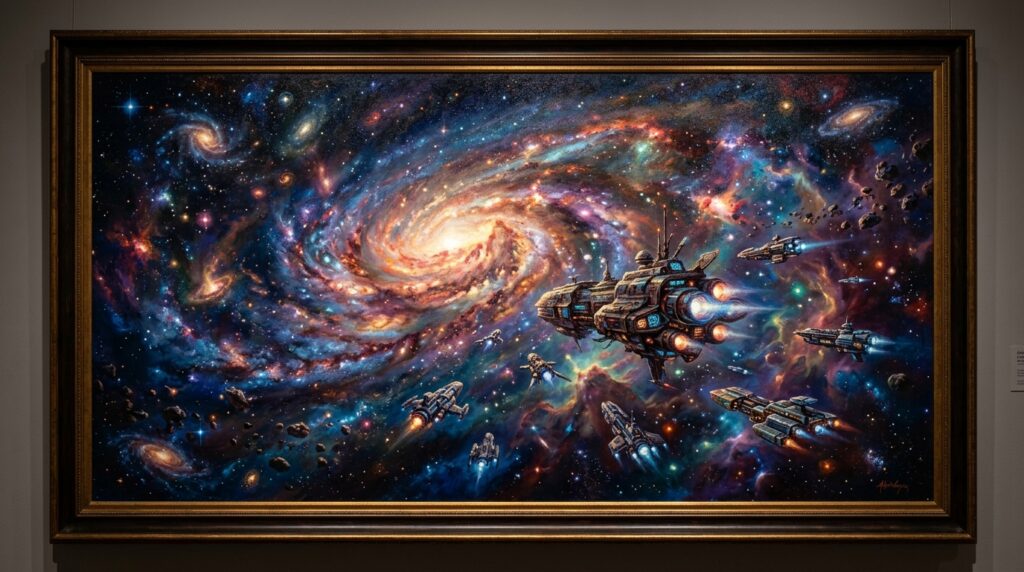
An alternate universe where the Old Ones wear lab coats — and it’s somehow more terrifying
June 6, 20264 min readLovecraft · Counterfactual · Horror · Sci-Fi
Here is a thought experiment I cannot stop turning over: what if H.P. Lovecraft — the man who gave us Cthulhu, the Necronomicon, and the singular adjective “eldritch” — had channelled his obsessions not into cosmic horror mythology, but into hard science fiction? Not a softened, sanitized version of Lovecraft. The full Lovecraft. The dread, the insignificance, the dawning comprehension that the universe is not hostile to humanity but simply indifferent to it — all of it, just wearing the clothing of science instead of the supernatural.
It is, I think, the most interesting “what if” in speculative fiction. Because the raw material was already there.
The secret: he was almost already doing it
Read At the Mountains of Madness with fresh eyes and tell me it isn’t science fiction. An Antarctic expedition. Ancient geological strata. A species — the Elder Things — whose biology is described with painstaking, almost clinical detail. The horror doesn’t come from magic. It comes from scale, from deep time, from the discovery that everything humanity has ever built sits atop a sediment of civilizations we cannot comprehend. That’s not supernatural. That’s cosmology.
Lovecraft was a devoted amateur scientist. He wrote astronomy columns. He corresponded with physicists. He was genuinely enthralled by what early twentieth-century science was revealing — that the universe was incomprehensibly vast, incomprehensibly old, and built on rules that had no obligation to make human beings feel comfortable. He didn’t need to invent cosmic dread. He just read the papers.
“The most merciful thing in the world, I think, is the inability of the human mind to correlate all its contents.” Swap ‘mind’ for ‘model’ and you have the opening line of the greatest hard sci-fi novel never written.
What his sci-fi would have looked like: a speculative inventory
I
The cosmological horror would have become first contact fiction. Cthulhu, stripped of mythos and dressed in biology, is already an alien intelligence whose cognition is so structurally different from ours that communication isn’t impossible — it’s a category error. In a sci-fi frame, that becomes the most chilling first-contact premise imaginable. Not war. Not wonder. Just the mutual, dawning recognition that neither species has the cognitive architecture to register the other as meaningful. Arthur C. Clarke gestured at this. Lovecraft would have lived there.
II
He would have pioneered deep-time fiction decades before it had a name. His horror was always fundamentally temporal — the past pressing up through the floor of the present. In hard sci-fi, that instinct translates directly. Stories set across geological eons. Civilizations that rose and fell before multicellular life existed on Earth. The kind of narrative that makes Kim Stanley Robinson’s longest books feel like short stories. He had the appetite for it. He just needed the framework.
III
His scientists would have been the most believable in the genre. Lovecraft’s protagonists are almost always academics and researchers — folklorists, archaeologists, marine biologists, geologists. He understood how scientists think, how they document, how they resist conclusions until the evidence becomes too monstrous to deny. That slow epistemic capitulation — the researcher’s notebook as horror vehicle — is already one of his greatest tools. In sci-fi, it would have been extraordinary. Think: field reports from the edge of a galaxy, written in the dry language of peer review, slowly becoming something else.
IV
The indifference of the universe would have become his central theme — and it would have been rigorous. Lovecraft’s philosophical core is that the cosmos has no interest in human flourishing. This isn’t pessimism. It’s thermodynamics. It’s the actual content of modern astrophysics, delivered without comfort. In a sci-fi frame, Lovecraft stops being a gothic eccentric and starts sounding like a hard-nosed materialist — a bleaker, more lyrical Carl Sagan, one who found the scale of the universe terrifying rather than humbling.
V
He would have written the definitive fiction about the limits of human cognition. His recurring image — the mind that glimpses something true about reality and breaks — maps perfectly onto a genre obsessed with post-human intelligence, simulation theory, and the hard problem of consciousness. Imagine Lovecraft engaging seriously with what it means that the human brain evolved to navigate a savanna and is now trying to comprehend quantum mechanics. The horror isn’t monsters. It’s the instrument itself.
Lovecraft vs. his contemporaries: the road not taken
What Asimov gave us
Rational optimism at scale
Civilizations that fall and rise predictably; science as the long game humanity wins through patience and institutions
What Lovecraft would have given us
Rational terror at scale
Civilizations that discover, too late, that winning was never one of the available outcomes; science as the instrument of our undoing
What Clarke gave us
Transcendence as destination
Humanity evolving toward something greater; the cosmos as a ladder we are, slowly, climbing
What Lovecraft would have given us
Transcendence as dissolution
Humanity evolving just enough to understand what we are — a brief, local fluctuation in entropy — and then falling silent
The uncomfortable truth about his actual legacy
Here’s the thing I keep arriving at: Lovecraft already shaped science fiction, without ever technically writing it. The New Wave writers absorbed him. Jeff VanderMeer’s Southern Reach trilogy is Lovecraftian sci-fi. Peter Watts’ Blindsight — perhaps the most philosophically rigorous first-contact novel ever written — is built on a Lovecraftian premise: what if the thing we encounter has no inner life, no consciousness, and is terrifyingly more effective for it? The influence seeped through the wall between genres whether Lovecraft intended it or not.
What we lost, by him staying in horror, is a body of work that could have been the dark mirror to Asimov’s hopeful one — equally rigorous, equally vast in scope, and utterly without consolation. Science fiction has always needed that voice. It still does.
At a glance: the alternate canon
| Lovecraftian instinct | Horror expression | Sci-fi equivalent | Genre impact |
|---|---|---|---|
| Cosmic indifference | Ancient gods who do not notice humanity | Hard physics; a universe governed by entropy with no anthropic exceptions | Would have pre-empted the “dark forest” theory by decades |
| Deep time | Pre-human civilizations beneath the earth | Geological and cosmological narrative spanning billions of years | A founding text for what we now call “big history” fiction |
| Cognitive limits | Minds broken by forbidden knowledge | Hard limits of human cognition against post-human or alien intelligence | Would have enriched consciousness studies in fiction by fifty years |
| Alien biology | Tentacled horrors from beyond | Rigorous xenobiology; life built on non-carbon chemistry, non-sequential cognition | First-contact fiction with genuine epistemic humility about what “contact” means |
| Scientist as protagonist | The doomed researcher who sees too much | The empiricist forced to document their own obsolescence | A new archetype: the narrator who is right about everything and saved by nothing |
— Written by someone who reads Blindsight every two years as a corrective, and who suspects Lovecraft would have approved.
Promoting my personal Sci-Fi blog with Advertisement Tracking Software.